


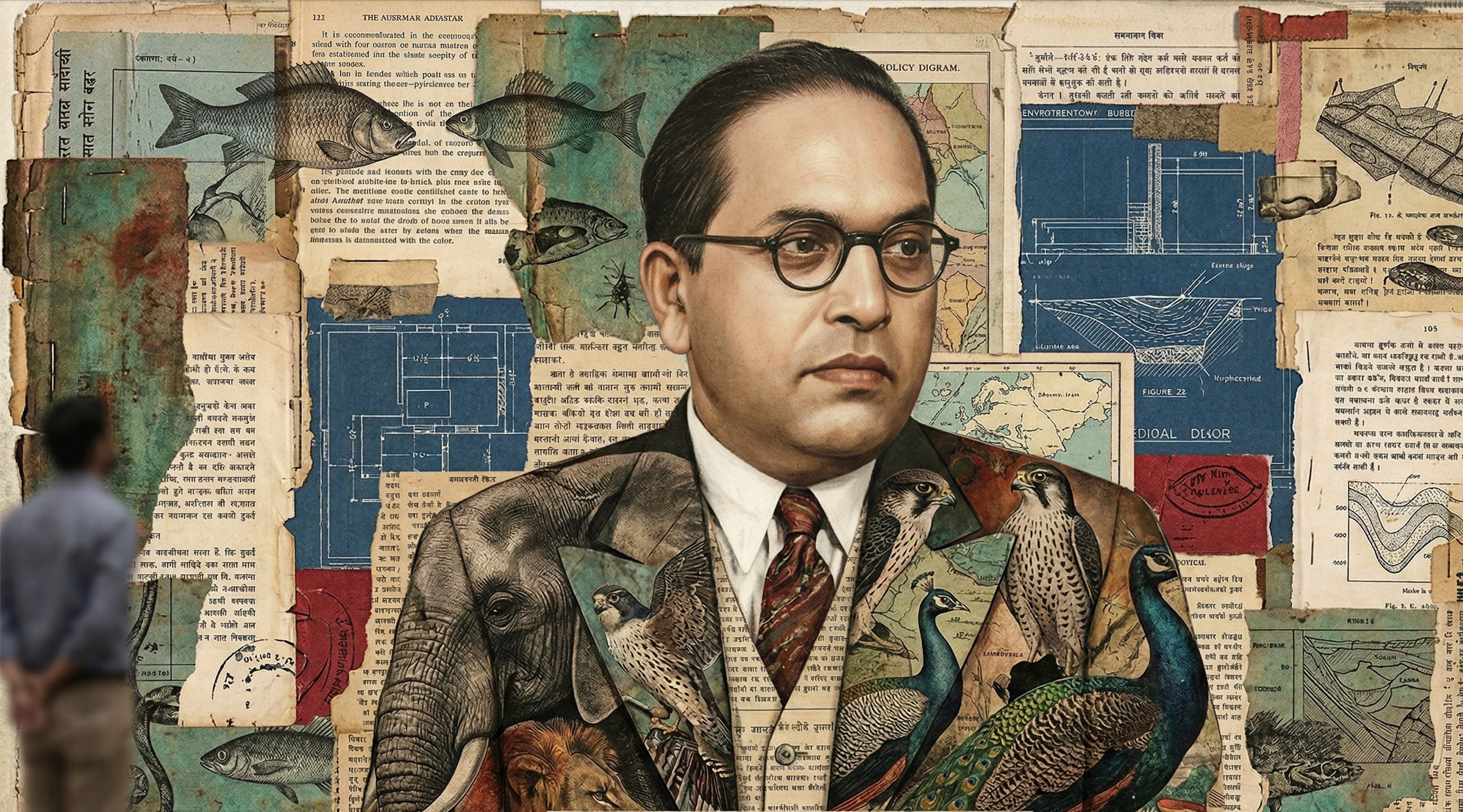
Intro by AMV: Most people know B. R. Ambedkar as a mind that reshaped a country, through law, through language, through an unrelenting clarity about injustice.
There is no shortage of research on the remarkable life and thought of Ambedkar. What is harder to find is the quieter life, the small, almost forgettable details that do not look like history, but reveal the emotional world of the man who changed the shape of this country.
This guest post stays with those details. The mundane, the intimate, the parts that rarely get recorded. Over to S. P. V. A. Sairam.
To love animals and to be loved by them undoubtedly constitutes a profound spiritual experience. The enormous and boundless joy one feels while playing with pets may never be accurately captured in words. The sense of fulfilment is truly staggering, often imparting an ethereal feeling of belonging to a wider cosmos, something beyond the realm of merely human. This is probably why the great French poet Anatole France remarked: “Until one has loved an animal, a part of one’s soul remains unawakened.”
In this context, it is exciting to inquire into and learn about the impact of animals on the life of the greatest maker of modern India, Dr. Babasaheb Ambedkar. Although many biographies are being written on Dr. Ambedkar, most confine themselves to documenting his enduring contributions to law, economics, constitutional jurisprudence and so on, while paying little or no attention to his private life. As a result, an impression is created that he hardly had the opportunity to experience those small, mundane moments that constitute the essence of a fulfilled life.
How accurate is this impression? In my close examination of the writings, speeches and correspondence of Dr. Ambedkar, guided by Mies van der Rohe’s conviction that God dwells in the details, I discovered an extraordinary wealth of information about his private life that is yet to be documented. Having realised the utmost significance of this material, I set out to chronicle it.
In my previous article, I documented the movies that Dr. Ambedkar watched and the interactions he had with film stars and musicians of his era. In this essay, I turn to a different aspect of his private life, collecting information about his pets, their names, their stories, and the forgotten anecdotes surrounding them to reveal the profound solace Babasaheb found in the company of these lovely animals.
I. The Goat in the Chawl
Young Bhim was nearly 12 years old when his family moved from Satara to a chawl in Bombay city in 1903. His father, Ramji Maloji Sakpal, had twin objectives in mind in making this decision, namely, to escape from the brutalities of the caste system in rural Maharashtra and to secure better educational prospects for his children. Around 1911 or 1912, Young Bhim’s family moved to a new place in the city called Bombay Improvement Trust (BIT) chawl No. 1, situated in Parel.
In the BIT chawl, they lived on the second floor where they had two small rooms [Room No 50 and 51] situated opposite each other. Room No. 50 was used as a study-cum-sitting room, while the room opposite, Room No. 51, was used for household purposes.
Besides providing space for Young Bhim, his father, and nearly ten other family members, these two tiny rooms offered shelter to a loving she-goat! This she goat was one of the first few pets documented in the literature connected to Babasaheb. Unfortunately, apart from this basic detail, we do not know anything about her. The very fact that it was specifically mentioned by Babasaheb in some of his speeches might indicate the nature of affection that he had for this lovely goat.
This BIT chawl was created in response to the deadly bubonic plague that killed thousands of people in the Bombay province between 1896 and 1897 [Savitrimai Phule passed away during the same period while carrying an Untouchable Mahar boy to a hospital]. According to the British colonial government, the overcrowded spaces in Bombay acted as the incubators of contagious diseases like Plague, and they had set out to mitigate the trouble by building new homes for the poor by dismantling the slums.
In this process, they entrusted the task to Bombay Improvement Trust [which was modelled on City of Glasgow Improvement Trust], which allocated homes to the poor in different chawls based on caste! That is why, Young Bhim’s family lived in tenements among mostly other untouchable families.
II. The Dogs He Loved
“When the Man waked up he said, ‘What is Wild Dog doing here?’ And the Woman said, ‘His name is not Wild Dog anymore, but the First Friend, because he will be our friend for always and always and always.”
– Rudyard Kipling, Just So Stories [page 204]
Dr. Ambedkar kept many dogs throughout his life. We gain a clear sense of the enormous love Dr. Ambedkar had for dogs through the books written by his associates. Among these, it is Nanak Chand Rattu who gives a fascinating account of this love:
“During my close association with Dr. Babasaheb Ambedkar till his last breath I have had the honour and privilege to watch him from a very close distance, his love for pet animals, especially the dogs to which he had an irresistible fascination and liking, probably they are so faithful. He would bring one from the farthest corner of the country if his eyes fell on a charming, good breed and would be prepared to pay any price…
Whenever he went out for long, he always instructed the servant to pay special attention to the dogs. He would even inquire about the health of the dogs in his absence. He never stopped worrying about the dog till he saw him on his coming back. He would even inquire about the health of the dog on phone, give instructions …. he would like that the dog was brought at the Aerodrome, coming out he would immediately look at the dog approaching him and pat.”
While we may not know the names and stories of all those wonderful dogs who gave immense joy to Babasaheb, we can still make an attempt to get acquainted with a few of them.
Tobby, and the Grief That Followed
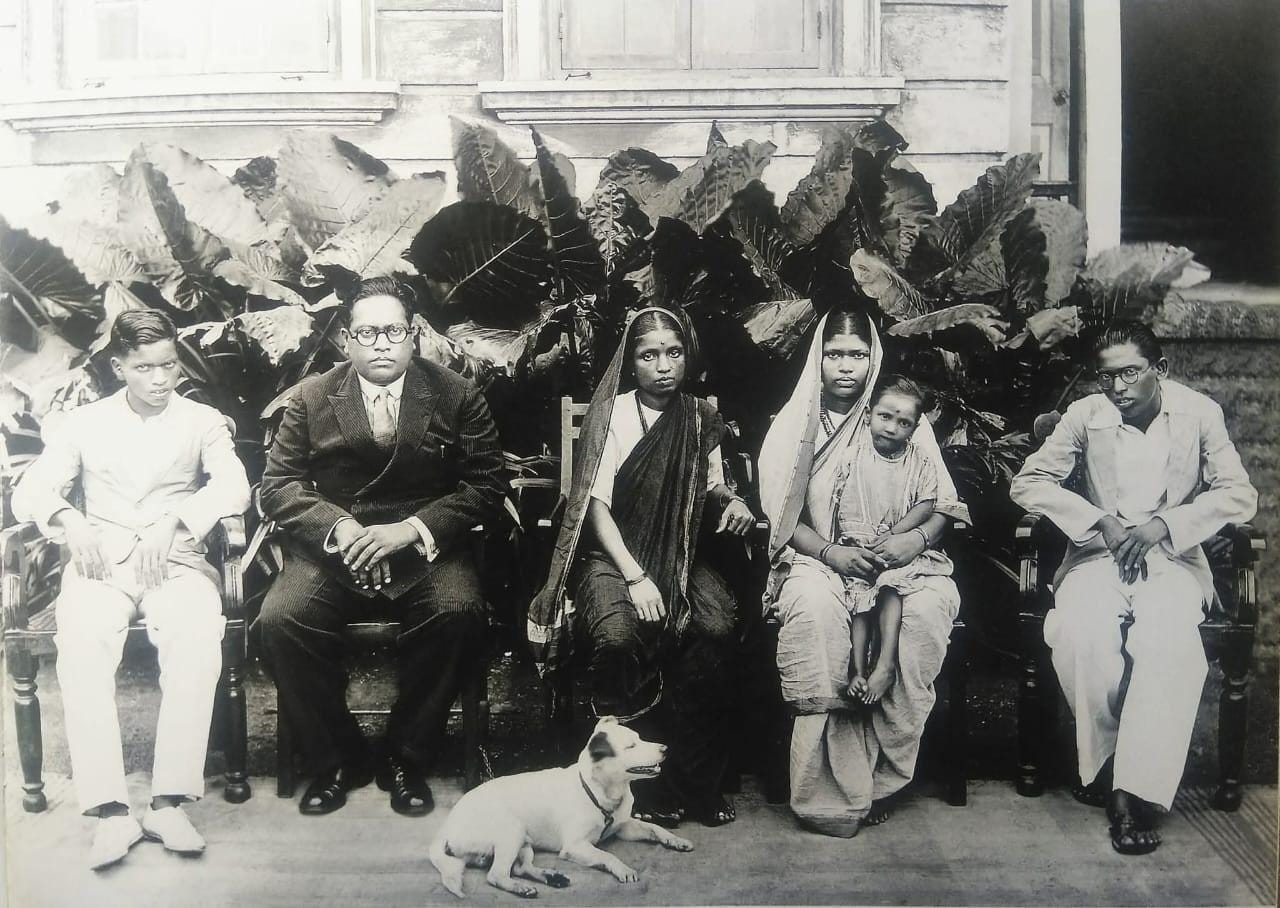
Let us meet Tobby first. There are two accounts related to him or her. On the one hand, it is generally suggested that this fox terrier dog named Tobby stayed with Dr. Ambedkar at Rajgruha during the late 1920s and early 1930s. We can even find the picture of this dog in the family photo of Dr. Ambedkar in 1934, which I share below:
On the other hand, Nanak Chand Rattu, who became a personal assistant to Babasaheb in 1940s, mentions about a dog with the same name, Tobby. Recalling the intense love and attachment that Dr. Ambedkar had for Tobby, Rattu recorded:
“Tobby, his pet dog at Bombay accidentally caught its paw in a door and cried the loudest. As he saw the dog with a bandage around its paw, he was worried and managed to send the dog to the veterinary hospital. When Tobby fell ill, he too often inquired after his health, visiting the dog in hospital twice a day.”
When Tobby passed away, it became nearly impossible for the associates of Babasaheb to console him, as Rattu writes:
“When news came to him that the poor dog had died this shocked him so terribly that he rolled in his chair like a bereaved mother, that for the rest of the day and for several days afterwards he was cast in a deepest gloom and constantly muttered ‘Poor Tobby’ and would go to have a glance where the dog used to lie” 4
When Rattu discusses Tobby, it is not clear whether he is referring to the dog that lived at Rajgruha between 1920s to 1930s [as seen in the photograph above], or to another dog that lived with Babasaheb in the late 1940s [when he joined as PA to Babasaheb]. If the description above refers to the dog that lived in the late 1940s, then the dog featured in the family photograph of Dr. Ambedkar is not Tobby. If that is the case, what was his or her name? Perhaps, we might find an answer to it if we examine the old Marathi books written on the early days of Babasaheb.
The story of Jeel and Peter
Next comes the beautiful dog, Jeel. She was owned by Barrister M. B. Samarth, who was a close friend of Dr. Ambedkar. Besides sharing a love for reading books and a commitment to social transformation, what strengthened the bond between Dr. Ambedkar and Barrister M. B. Samarth was their love for animals, particularly dogs. As I have discussed in my previous articles, M. B. Samarth was the paternal uncle of the famous Hindi actress Nutan.
In those times, the Samarth family used to have a dog called Jeel of the Vilayati or foreign breed. Dr. Ambedkar loved her so much that whenever he visited the home of Samarth, he would spend time playing with her. After Jeel passed away, Babasaheb was deeply saddened. Later, he took one of her puppies to Rajgruha as a token of love for Jeel. Babasaheb named this jewel from Jeel as ‘Peter’. Our Peter had the good fortune to spend time with Babasaheb in both Bombay and Delhi.
Mohini, and the Rhythm of His Days
Of all of Dr. Ambedkar’s dogs, Mohini is perhaps the one who was photographed the most! With brown, silky hair and long, flowing ears, she was undoubtedly one of the most energetic dogs that Babasaheb ever had. For a brief account of her, we must turn again to Rattu. Speaking about the daily morning ritual of Mohini, he wrote:
“Early in the morning, Mohini would quietly enter room wagging her tail, to get the morning pat, raising her paw as if to shake hands and then the great scholar would know that this was morning. He would then divert his attention for a while, taking the dog in his lap, fondle with her with a patting and exclaim: “So, you are here to tell me, this is morning. You are so good. Alright, now go and have your milk”. So saying he would again start on the job, reading and writing.”
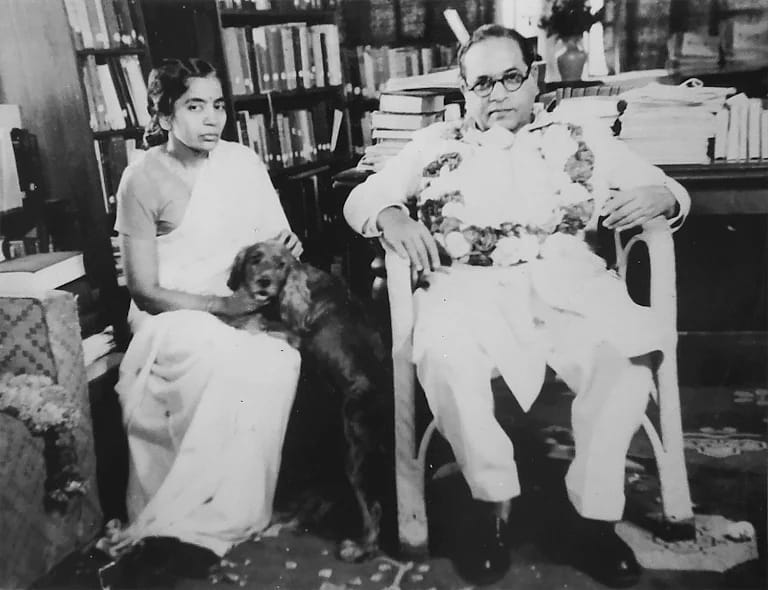
On the fascinating bond of love between Babasaheb and Mohini, he wrote:
“She was the most loveable. Dr. Ambedkar would too often take her in his lap, pat and fondle and she was also very responsive to his calling.…In the evenings, sitting in the lawns of the bungalow, Mohini would run around his chair, dance and play, all of a sudden, she would then raise her paw as if to shake hand which the great man immediately responded, much to the joy of the onlookers.
The dog would then immediately leap on to lick his hands and face and he would fondle with her for long, taking her into his lap and talk to her in a very passionate and friendly way. He would ask her whether she had taken milk and food. He called her Bhikni. He would then persuade her to lie near his feet and curl up in sleep. Mohini would stay with Babasaheb while he was drafting the articles of constitution all throughout the night.
…Whenever Dr. Ambedkar went out Mohini would sit at the entrance of the bungalow and wait for the arrival of her master. At the very sight of the car entering the premises she would escort running ahead of it with wagging tail, with a wide dance. As the great man came out, she would immediately cling raising her paw to get a patting.
…While Dr. Ambedkar was away to Kathmandu to attend the World Buddhist Conference, Mohini had been admitted to dog hospital. On his return, coming out of the plane, the first thing he asked me was about the health of the dog. Such was his love for the pet dogs.” 7
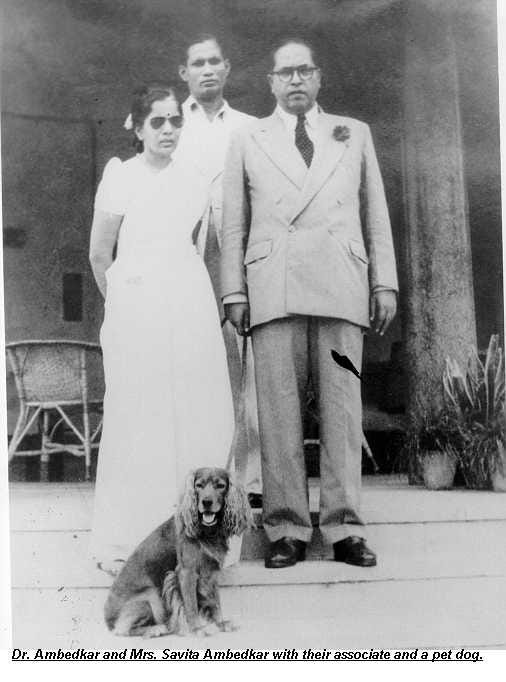
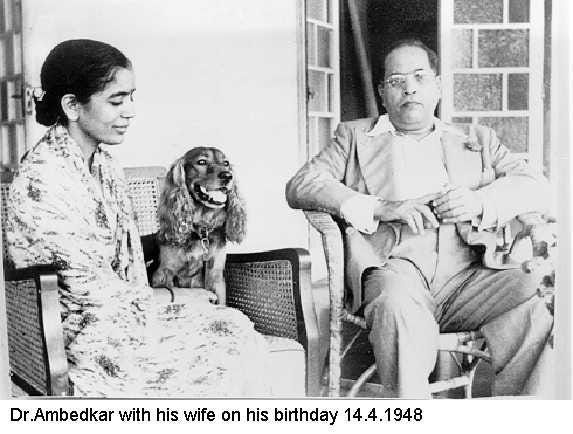
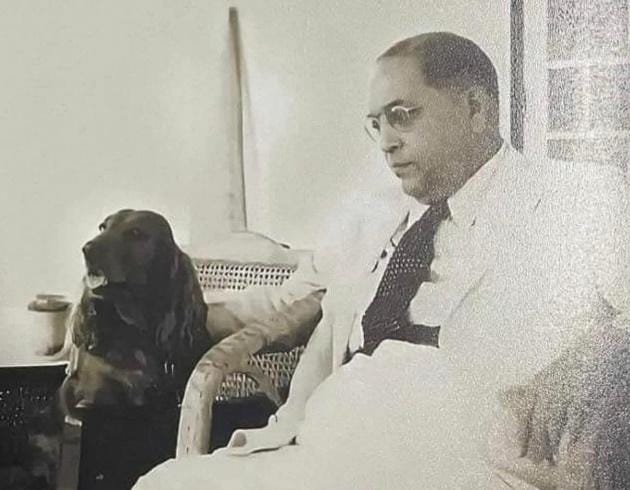
As the Chairman of the Drafting committee of the Constitution of India, it was a daily routine for Dr. Ambedkar to immerse himself in his work after returning from Parliament, with little or no rest. Dr. Ambedkar’s health was already deteriorating then, and the task of preparing the Constitution of independent India took a heavy toll on his already fragile health. In one of his letters addressed to Kamalakant Chitre on 31st August [1947], Dr. Ambedkar wrote:
“My health is on the down-grade. For the last fifteen days I have not had a wink of sleep, the nights have [become] a nightmare to me. The neurotic pain always comes at midnight and continues throughout. I am taking insulin as well as homeopathic medicine. Neither seems to give me relief. I must now learn to endure what appears beyond cure”
Dr. Savita Ambedkar, who took immense care of Babasaheb after their marriage in 1948, and who had worked relentlessly to extend the lifespan of Dr. Ambedkar made the following observations:
“The Constitution of independent India was altogether the creation of Dr Ambedkar. He worked on it for sixteen to eighteen hours every day at a stretch. He would say, ‘I am repaying my debt to the people of this soil.’… Dr Ambedkar had already been suffering from diabetes, rheumatism, neurological pains and a host of other ailments. The pain in his legs would flare up every now and again, as a result of which he would not be able to sleep for fifteen days at a stretch, writhing in bed all through the night. Pressing his limbs, giving his legs an oil massage, fomenting his legs with a warmed-up brick wrapped in a towel whenever his neural and leg pains flared up, I would always be anxious to find ways to bring relief to him in some way or the other.8
During this unimaginably hectic and challenging period between 1947 and 1950, Mohini would accompany the learned doctor all throughout the night as he worked tirelessly to draft the provisions related to the Constitution, the Hindu Code Bill, and other laws. She would roll and wriggle at his feet, and he would gently pat her with affection. In the midst of tyrannical and fanatical humans, he found solace and contentment in the company of these innocent animals.
III. Dr. Ambedkar on How Animals Shaped the Early Human World
In his path-breaking sociological treatise titled “The Untouchables [1948]”, Dr. Ambedkar begins his discussion of the origin of Untouchability by delineating the distinction between nomadic and settled communities of the primitive human world.
In this context, he speaks about the significant role played by cattle in the life of nomadic communities:
“How did Primitive Society become a settled community?... Primitive Society was no doubt nomadic. But it was nomadic not because of any migratory instinct. Nor was it due to any mental trait peculiar to it. It was the result of the fact that the earliest form of the wealth held by Primitive Society was cattle… Primitive Society was migratory because its wealth, namely the cattle, was migratory. Cattle went after new pastures. Primitive Society by reason of its love for cattle, therefore, went wherever its cattle carried it. Primitive Society became fixed in its abode, in other words became a settled community, when a new species of wealth was discovered. This new species of wealth was land. This happened when Primitive Society learned the art of farming and of cultivating land. Wealth became fixed at one place when it changed its form from cattle to land. With this change Primitive Society also became settled at the same place.”
After discussing the evolution of human societies, Dr. Ambedkar gives a fascinating exposition of the concept of Broken Men by citing examples from Ireland [such as Brehon Laws], Wales and so on before turning to the question of Untouchability in India. For a more detailed account, readers should consult the original text.
Some of you might have already noticed from the above details that Dr. Ambedkar published this book in 1948, a period when he was intensely engaged in the making of India’s Constitution. I am sure it wouldn’t be an exaggeration to say that only Dr. Ambedkar could write and publish an in-depth sociological book that addresses questions such as the origin of untouchability – a remarkable feat that no sociologist or anthropologist before or after Babasaheb could achieve - while simultaneously preparing a constitution for a massive country like India. Truly, Ekach Saheb Babasaheb!
IV. The Books That Shaped His Curiosity About Animals
A mere glance at his massive library reveals that Dr. Ambedkar possessed numerous books [more than 60,000] on a wide range of subjects, ranging from politics, law, and economics to astrophysics [including relativity], anatomy of muscles, psychoanalysis, plant physiology, and ethology [the science of animal behaviour].
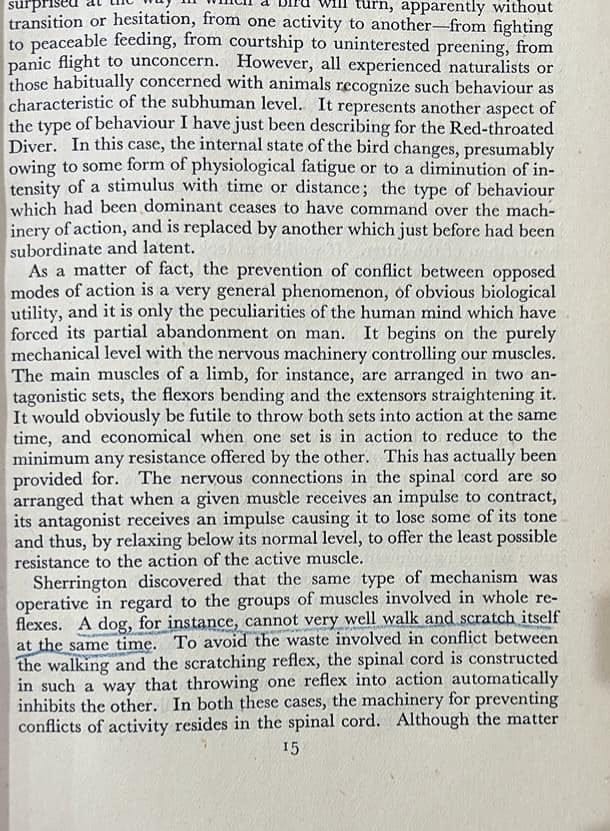
Knowing this, I have often wondered which books Dr. Ambedkar read on contemporary developments in the domains of Evolution and Ethology. As luck would have it, while browsing Facebook, I came across a terrific post shared by former civil servant and scholar Mangesh Dahiwale, in which he shared images from Dr. Ambedkar’s copy of “Man in the Modern World” authored by the preeminent evolutionary biologist Julian Huxley. 9
What strikes me most in these images is that the book is heavily underlined, which speaks volumes about Babasaheb’s interest in evolutionary biology and ethology. Since the book discusses animals, including references to dogs, I take the liberty of sharing a few excerpts from the underlined passages.
Huxley discusses the fate of the three highest animal groups in evolutionary history - the molluscs, the arthropods, and the vertebrates - and why the Molluscs couldn’t succeed better than the other two groups. The explanation given by Huxley piqued Dr. Ambedkar’s interest, as evidenced by the underlined portion from the book:
“What was it that cut the insects off from progress? The answer appears to lie in their breathing mechanism.” [For detailed explanation, see from page 14 of the book]
Having shown why the insects reached the end of their blind alley, Huxley proceeds to discuss the divergent lines that reptiles, birds and mammals took in the evolutionary past. Here too, Dr. Ambedkar found the whole discussion quite interesting, as the underlined words testify:
“Temperature regulation is a necessary basis for final progress…Two reptilian lines achieved this next step, in the guise of the birds and the mammals. The birds soon, however, came to a dead end, chiefly because their forelimbs were entirely taken up in the specialization for flight…. Most mammalian lines, however „cut themselves off from indefinite progress by one-sided evolution, turning their limbs and jaws into specialized and therefore limited instruments.”
After a few pages, the analysis proceeds to discuss the flexors and extensors [muscle groups] of limbs, in which a reference is made to dogs. The dog lover in Babasaheb was quick to catch the point, as can be seen below:
V. The Birds He Cared For
Associates of Babasaheb, like Devi Dayal, noted that Dr. Ambedkar would regularly fill the bird water feeders to quench the thirst of birds like sparrows, parrots and other migratory avians. 10 It has been recorded by Rattu that whenever Dr. Ambedkar cut his fingernails and toenails, he would collect all the nail clippings in a cloth and dispose of them safely. When asked by Rattu about this habit, Babasaheb told him that he did it to prevent the injury [or even death] to small birds from ingesting the nail clippings!
The above instances throw a flood of light on the deeply emotional bond that Dr. Ambedkar shared with animals, particularly dogs and birds. In this context, it is not surprising that he found Buddhism close to his heart. For Buddha too, just like Babasaheb, had immeasurable love for animals.
Interesting as it is, Dr. Ambedkar describes a moving tale of the young Siddhartha in his magnum opus “Buddha and his Dhamma” that speaks volumes about the blessed lord’s compassionate heart:
“His childhood was marked by the presence of supreme sense of compassion. Once he went to his father’s farm. During recess he was resting under a tree enjoying the peace and beauty of nature. While so seated a bird fell from the sky just in front of him. The bird had been shot at by an arrow which had pierced its body and was fluttering about in great agony. Siddharth rushed to the help of the bird. He removed the arrow, dressed its wound and gave it water to drink. He picked up the bird, came to the place where he was seated and wrapped up the bird in his upper garment and held it next to his chest to give it warmth: Siddharth was wondering who could have shot this innocent bird.
Before long there came his cousin Devadatta armed with all the implements of shooting. He told Siddharth that he had shot a bird flying in the sky, the bird was wounded but it flew some distance and fell somewhere there, and asked him if he had seen it. Siddharth replied in the affirmative and showed him the bird which had by that time completely recovered…Devadatta demanded that the bird be handed over to him. This Siddharth refused to do. A sharp argument ensued between the two. Devadatta argued that he was the owner of the bird because by the rules of the game, he who kills a game becomes the owner of the game. Siddharth denied the validity of the rule. He argued that it is only he who protects that has the right to claim ownership. How can he who wants to kill be the owner?
Neither party would yield. The matter was referred to arbitration. The arbitrator upheld the point of view of Siddharth Gautama. Devadatta became his permanent enemy. But Gautama’s spirit of compassion was so great that he preferred to save the life of an innocent bird to securing the goodwill of his cousin. Such were the traits of character found in the early life of Siddharth Gautama”
There are many stories in the Buddhist literature in which Buddha takes the form of animals to deliver moral sermons. A striking example is the Kukkura Jātaka.
This Jātaka recounts the tale of a Bodhisatta who was born as a wise dog [an extraordinary example of anthropomorphism], leading a pack in a massive cemetery. One day, when the King of Benares, Brahmadatta, learns that the leather of his chariot had been gnawed, he hastily ordered a massacre of dogs. To save his kin, the Bodhisatta entered the king’s palace with unflinching bravery and confronted the king in the following way:
“Is it you who are having the dogs destroyed?” “Yes, it is I.” “What is their offence, king of men?” “They have been gnawing the straps and the leather covering my carriage.” “Do you know the dogs who actually did the mischief?” “No, I do not.” “But, your majesty, if you do not know for certain the real culprits, it is not right to order the destruction of every dog that is seen.” “It was because dogs had gnawed the leather of my carriage that I ordered them all to be killed.” “Do your people kill all dogs without exception; or are there some dogs who are spared?” “Some are spared,—the thorough-bred dogs of my own palace.”
… “Sire, just now you were saying that you had ordered the universal slaughter of all dogs wherever found, because dogs had gnawed the leather of your carriage; whereas, now, you say that the thorough-bred dogs of your own palace escape death. Therefore you are following the four Evil Courses of partiality, dislike, ignorance and fear. Such courses are wrong, and not kinglike. For kings in trying cases should be as unbiassed as the beam of a balance. But in this instance, since the royal dogs go scot-free, whilst poor dogs are killed, this is not the impartial doom of all dogs alike, but only the slaughter of poor dogs,”
Impressed by these words of wisdom, the king asked the Bodhisatta to throw light on the real culprits. In order to expose the real culprits, the Bodhisatta mixed the buttermilk with kusa grass and fed the palace dogs. As they drank it, the palace dogs began to vomit pieces of leather one after the other. Having witnessed the entire scene, the king understood who the culprits were, and “commanded that the lives of all creatures should be safe from harm. He ordered that all dogs from the Bodhisatta downwards, should have a constant supply of food such as he himself ate; and, abiding by the teachings of the Bodhisatta, he spent his life long in charity and other good deeds”
The vast Buddhist literature [particularly in Pali] contains not only the essential teachings and timeless wisdom of the Tathāgata Buddha but also serves as a massive repository of innumerable historical accounts, myths and floating legends of a multitude of independent tribes and sects from ancient Indian history.
Having fully appreciated the significance of Pali sources in unearthing the past, Dr. Ambedkar compiled an entire dictionary of the Pali language, comprising more than 12,000 entries, and translated it into four languages [Marathi, Gujarati, Hindi and English] so that students and scholars who wish to understand, analyse and document the true history of Ancient India may use his dictionary as a guide in their quest to exhume the past. Speaking on the same, Dr. Ambedkar remarked:
“Ancient Indian history must be exhumed. Without its exhumation Ancient India will go without history. Fortunately, with the help of the Buddhist literature, Ancient Indian History can be dug out of the debris which the Brahmin writers have heaped upon in a fit of madness.
The Buddhist literature helps a great deal to remove the debris and see the underlying substance quite clearly and distinctly. The Buddhist literature shows that the Devas were a community of human beings. There are so many Devas who come to the Buddha to have their doubts and difficulties removed. How could this be unless the Devas were human beings.
…Again, the Buddhist canonical literature throws a flood of light on the puzzling question of the Nagas. It makes a distinction between womb- born Nagas and egg-born Nagas and thereby making it clear that the word Naga has two-fold meaning. In its original sense it stood for the name of a human community…. With this exhumation of debris, we can see Ancient Indian History in a new light.”
VI. The Meaning of Maitri
It must be remembered that not everyone who loves animals would extends the same degree of concern to humans, and vice versa. We know how brutal humans are towards animals. It is equally true that there is no dearth of hypocrites who feed sugar to ants but kill humans for exercising their basic human rights, without any sense of remorse.
For them, so-called concern for animals takes precedence over the basic rights of humanity. Crores of people may perish in utter poverty, millions of children may remain stunted and wasted, and many more may spend their lives in an extremely disadvantaged state of exploitation and abuse, yet their conscience remains hardly pricked. These same “apolitical” and arrogant people will suddenly wake from their deliberate deep slumber the moment something happens to animals.
One wonders why these active and responsible citizens do not display similar fire in questioning the injustice and ignominies to which fellow humans are subjected on a daily basis. Why limit the boundary of your love only to animals? Why not extend it to encompass the suffering humanity? It is highly possible that even this overt display of concern for animals might be just another deceptive performance exhibited by privileged castes to project themselves as true champions of love.
To conclude, it takes an extraordinary degree of moral fibre to possess unbounded and untainted love and concern for both humans as well as animals alike. As Buddha profoundly observed:
“Love is not enough; what is required is Maitri. It is wider than love. It means fellowship not merely with human beings but with all living beings. It is not confined to human beings. Is not such Maitri necessary? What else can give to all living beings the same happiness which one seeks for one’s own self, to keep the mind impartial, open to all, with affection for every one and hatred for none?
And Dr. Babasaheb Ambedkar was truly a Mahamaitrisagara [to coin a phrase] – the mighty ocean of Maitri, who has not only emancipated the sunken humanity but also bestowed unfathomable love upon all the living throughout his blessed life. Let us get inspired from the great life of Dr. Ambedkar and work to disseminate the spirit of Maitri – the foundation of a real democracy.
I end my essay by dedicating it in loving memory of my dogs, Shambhu, Simba, Sheero, Michael, Shambu, Simbha, Tobby and the two unnamed kittens of Alex.
Everyone likes long, thoughtful writing. Very few people pay for it.
If this piece gave you something, a new thought, a different way of looking, consider supporting the work. That is how more of this gets made.
About the author
Dr. S. P. V. A. Sairam is a dentist an independent researcher. He has been writing articles exploring the fascinating lives of Dr. Ambedkar, Phule couple, and medieval telugu posts since six years.
Some of his articles include “Recreating the lost library of Mahatma Jotiba Phule”, “Movies watched by Dr. Ambedkar”, “Beyond sacrifice: A comprehensive portrait of Ramabai Ambedkar” and so on.
You can find all his articles and talks by clicking this link
References:
1] Ambedkar Awakening India’s Social Conscience by Narendra Jadhav
2] Outcaste Bombay City Making and the Politics of the Poor by Juned Shaikh.
Although the book is informative, I found a few remarks that are objectionable. For example, by citing Khairmode, the author writes: “Sakpal’s family considered Dabak chawl respectable or proper (vyavasthita), while they deemed the places many other Dalits lived, often from the same Mahar jati, filthy. They had borrowed the existing discourse of sanitary and unsanitary housing in early twentieth-century Bombay and used it to highlight class or status distinctions within a caste group.”. There is no evidence to back this claim and a reference from Khairmode is as unreliable as a gossip from Goebbels, unless it is substantiated with other sources. To understand more about the distortions and disinformation shared by Khairmode, see Dr Bhagawan Dhande’s Babasahebaanchya Badnaamicha Mahaprakalp (The Mega Project to Defame Babasaheb).
3] Little known facets of Dr. B. R. Ambedkar by Nanak Chand Rattu
4] ibid
5] To know more about the association of Dr. Ambedkar with films and film stars, check my article https://www.theculturecafe.in/p/an-unexplored-side-of-dr-ambedkar?utm_campaign=post&utm_medium=web
6] डॉ बाबासाहेब आंबेडकर यांचे दलितेतर सहकारी. ले. योगीराज बागुल [Thanks to my friend Milind Patil for translating the relevant part for this article]
7] Little known facets of Dr. B. R. Ambedkar by Nanak Chand Rattu
8] Babasaheb My life with Dr. Ambedkar by Dr. Savita Ambedkar, pages 16, 90.
9] I thank Mangesh Dahiwale sir for sharing this invaluable reference https://www.facebook.com/share/p/1AczKrGRtR/
10] Daily routine of Dr. Ambedkar by Devi Dayal

Thank you for writing this article. I loved the details and the additional stories in the end. Also, I appreciate the nuance you added that not all animal lovers are good to their fellow humans. Thanks for noting the nuances in the sources as well. Very often some sources provide valuable facts but also have some objectionable opinions. You touched upon the topic of Dr Ambedkar’s library. I am really fascinated by his passion for books and that I think could be a theme for multiple articles.
this made me so emotional 🥺