


Recently, on a trip to Vietnam, I boarded a Grab from airport, which is their version of Uber. The cab driver kept all four windows open and seemed some kind of oxygen enthusiast. The weather was slightly humid but bearable, so I didn’t bother asking him to switch on the AC. He was even humming a song and I thought may be he is creating certain atmosphere for his art to flourish. But still, why not just switch on the AC? Was it because of the gas shortage due to Iran war?
Then at a traffic signal I felt a blast of cold air on my face. The AC was already on. He had the AC running and the windows open. Just for vibes.
My Indian brain could not process this arrangement. In India we are taught that every unit of AC air is sacred and shall not be wasted. Windows and doors must remain tightly shut when the lord AC is humming. Even at shops and homes, the moment someone opens the door for two seconds, panic spreads instantly. Arrey darwaja band karo, AC on hai (Shut the door, AC is on).
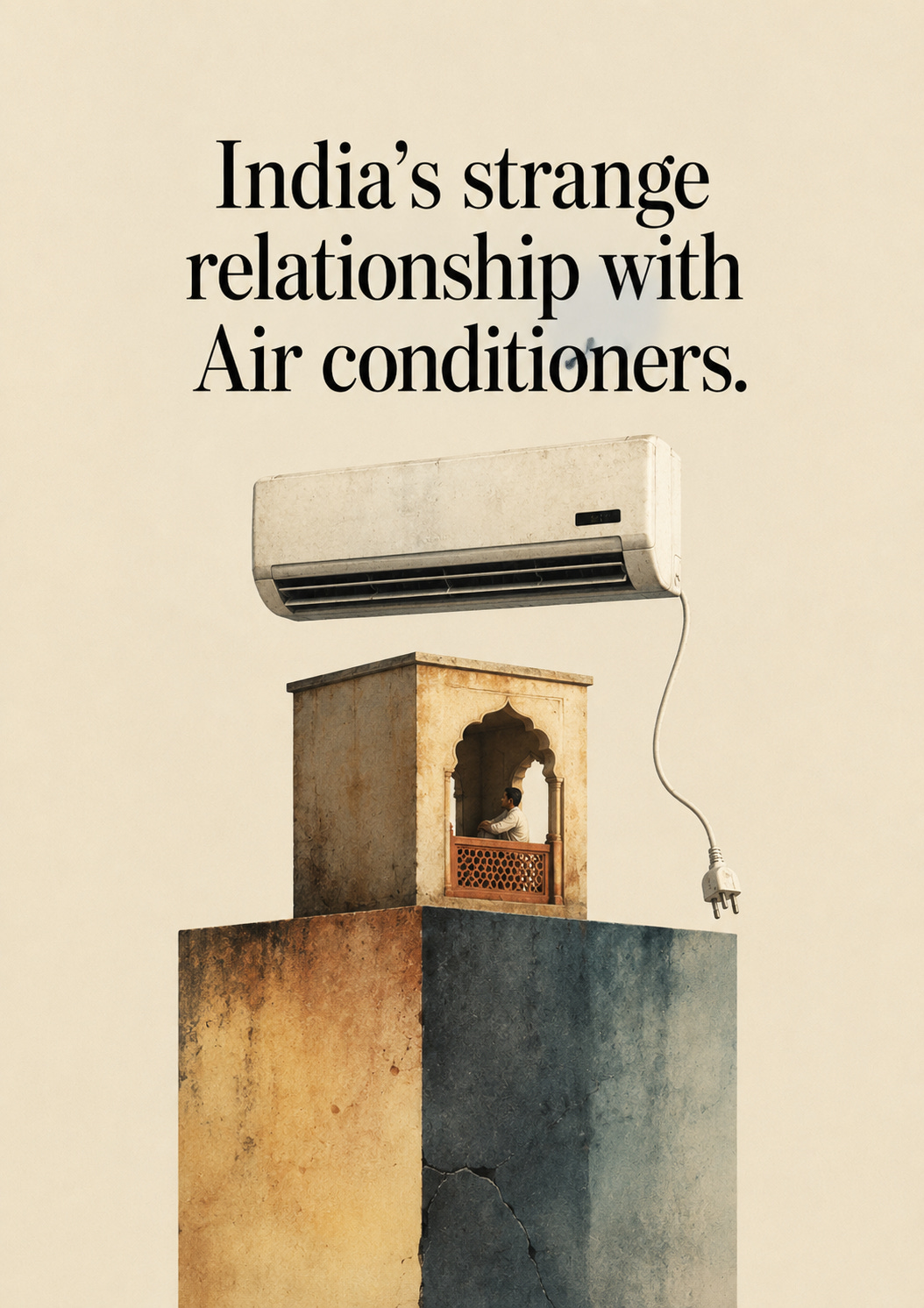
AC in India has always carried the aura of something rare and precious.
It is also the ultimate form of debauchery. A sign of decadence. The AC person is imagined as soft, cuddled inside a cloud of his own privilege, while the real hardworking people are out there surviving the road, the dust and the heat. Recently, Union Minister Jyotiraditya Scindia said this while trying to sound relatable to the poor people of his constituency: “I don’t use air conditioning in my car, nor do I sit in an air-conditioned environment. And when people ask me, even in the 51-degree heat of May and June, I say, This is Chambal skin. Keep an onion in your pocket. Nothing will happen to you.” He said this while wearing a watch reportedly worth several lakhs.
Finally, the perfect Onion headline, if you know what I mean.
The statement is bizarre but not random. It comes from a classical Indian mentality. He wanted to dissociate himself from the “AC crowd” despite obviously having AC in his house and cars. The AC is an accusation he felt the need to wipe off, and he clearly believes the crowd will love him for it. One of the more prominent slurs in Indian public life is “AC mein baith ke opinion dena.” In politics, the go-to attack on any opponent is “AC kamre se bahar to nikalo ek baar.”
In India, using AC is not just a debate about airflow. It is a debate about character flaw.
AC also created it’s own share of confrontational mini wars in India. One of the regular most viral confrontation videos between a Bengaluru cab driver and a north Indian passenger begins with a request to switch on the AC. These AC wars routinely escalate into regional language wars, with cab drivers telling passengers to first learn Kannada. Somewhere the inventors of air conditioning must be deeply confused that their machine accidentally became part of federal tensions in South Asia.
The AC air has always been some sort of priced possession. I remember how, in the pre demonetisation era, ATM booths had a strange aura around them because they were among the few public spaces with guaranteed air conditioning. Back in 2012, I would sometimes enter an ATM room and pretend to withdraw cash even when I knew there was no money in my account. You stood there for a minute or two, enjoying the cool air before stepping back onto the road to deal again with the kind of heat where sometimes even birds drop dead from trees.
In fact many people linger longer in malls because of AC. The Indian mall is basically heat refugee asylum disguised as consumerism.
In such an atmosphere, the launch of the Delhi Metro surprised many Indians with the revelation that it was perfectly acceptable to travel in AC and that the Indian government had finally decided to grant ordinary people air conditioned rides. Mumbai local trains resisted this idea for years despite operating inside a city that feels like somebody accidentally covered a sauna with concrete. When AC locals finally arrived in 2017, many commuters mocked them as unnecessary luxury.
Luxury is also a very flexible word in India. Almost anything can become luxury when viewed through relative terms.
When I was living in Mumbai, I gave my cooler to the watchman because I was shifting houses. Two days later he returned awkwardly and said the society manager wanted the cooler removed. Why? I asked. He replied: Yehi sab ki guard saala cooler ki hawa kha ke so jayega. Duty sahi se nahi karega (Guards will sleep after enjoying the cooler air. They won’t do his duty properly.)
The statement reveals an old Indian suspicion toward comfort. Espcially the comfort of working class people. The fear was that cooling would reduce obedience. A comfortable guard is not a real guard.
On my recent podcast my co-host Kartik reminded me of Singapore’s founding Prime Minister Lee Kuan Yew who famously said that air conditioning was one of the most important inventions in history. “ Air conditioning was a most important invention for us, perhaps one of the signal inventions of history. It changed the nature of civilization by making development possible in the tropics. Without air conditioning you can work only in the cool early-morning hours or at dusk. The first thing I did upon becoming prime minister was to install air conditioners in buildings where the civil service worked. This was key to public efficiency.”
Of-course there are also climate and carbon emission concerns around AC. Real and serious issues, mostly raised by people who own multiple AC units and have never removed a single one from their homes to set an example. The argument for reducing AC use is always directed outward, toward the “wide usage” by others. Let a small percentage of us enjoy the cold breeze. The rest can manage.
For people from lower income brackets, AC remains aspirational and openly flaunt-worthy. Recently I watched a reel of a woman from small town unpacking an air conditioner in her room. She put a tika on it first. Then came the caption: “AC le liya humein. Ab chahe jalne wale jale. Hum to thande mein hi baithenge.” Cut to feet-thumping insta music. ( translated as: We have bought an AC now. Let the jealous people burn if they want. We are going to sit in cool air on)
Perhaps in India, every degree lower in a room can feel like a step higher in society.
If you enjoyed this piece, you can support the work here by Buying me a Coffee:
Independent writing and podcasting survives on reader support. Every contribution helps keep this space free, interesting, and alive.
This is such an interesting conversation from something so relevant. When we look back over the years, Indians have had a habit of glorifying poverty, and labour, which is very evident through the Bollywood films of 70-80s. This mindset inherently criminalises comfort, and rest. We can also think about this by connecting the conversation to India’s economic history through the years, during and post colonisation. I think our mindset of glorifying labour is one of the key factors why Indian corporate culture does not respect work-life balance and Western companies prefer Indian employees.
Reminds me of that Anil Kapoor-Sridevi movie (Judaai?) where newly married Sridevi moves into Anil Kapoor's seemingly empty house and asks where's the AC, to which Anil Kapoor replies, "humare dil mein AC hai"
We're constantly fed this Angoor khatte hain narrative that we're happy wherever we are in our socio-economic status. We don't need ACs.