


Back in my school there was a teacher who looked cute, and was cute for the most part, but he carried a certain coldness towards senseless violence and used to beat boys as if it were a spiritual duty assigned to him, as if he were a mere human following the orders of the almighty. His name was Mr Goswami (not Arnab). One reason for the beatings was his utter disgust for contemporary haircuts. He could not bear the sight of long hair on boys, especially the kind inspired by Bollywood films. If he found any boy carrying that memory of the films, he would immediately launch a surgical strike on the rizz. In that sense he was anti-fashion, and wanted to crush whatever was in vogue to maintain a boring, fascist kind of sameness.
Fearing him, I never followed any Bollywood fashion and kept my hair short. I spent my school years performing the role of the obedient student, the one who spoke with utmost seriousness and passion at the school assembly: all Indians are brothers and sisters.
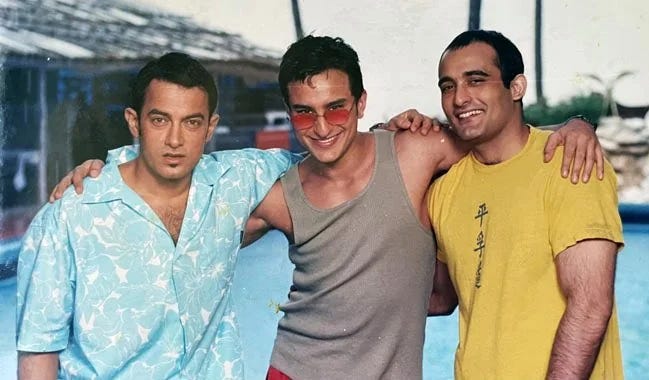
During the same era, a film came out that changed the culture of what counted as new and cool, and most importantly, made short hair cool. A new kind of fashion emerged, people moved back to short haircuts, and some adventurous ones even grew a thin, ‘Bingo Mad angle’ beard like the film’s lead hero.
Mr Goswami then became very happy, possibly smug, that everyone in the class now carried his short haircut maifesto, and he considered it a personal victory. But let me reveal a secret to you, Mr Goswami, today, from this Substack: this was not your victory. This was the victory of a film named Dil Chahta Hai.
But what Dil Chahta Hai changed in cinema is more than fashion. There is an entire vocabulary of a nation in flux buried inside it. The film completes 25 years this year (which makes me strangely feel old), and now is a good time to dissect it.
The Post Liberalisation Class
Dil Chahta Hai released in 2001, when India had experienced a decade of full post liberalisation. What the media of that time called the “boring person” (Manmohan Singh) was responsible for the most exciting times of the citizens.
The post liberalisation era and the new economy that developed from it gave us western inspired clothes, furniture, gadgets, satellite TV, and cold drinks with taglines such as “Yehi hai right choice baby, Aha!”
It opened up a class that had corporate jobs, that had MBA dreams in a pre-Shark Tank world, a class that had purchasing power. This is also an important change in the film, because in Bollywood, rich people had always existed as a binary, caricatured mostly as evil. The father would be played by a patriarch who did not approve of his daughter’s love, and who turned cruel the moment he learned she had fallen for someone whose salary which reads like 4 digit Uber OTP.
This is why money has always carried tension in Indian cinema, and why the stories were about an individual’s struggle to become rich and his eventual possession of that money.
But in this film, the characters are already rich, and the plot needs no struggle to get there. There is no tension around money, no anxiety, no show off, like in music videos where someone drives a flashy car and screams with a bundle of notes “jatt paida hoya chaan waste.” The film instead carries a European style of aesthetic, where money and leisure sit in the background. That money is never the victory. The real subject is how existential questions plague the human soul.
This is also the important point: for existential dilemmas to occur, the basics need to be cleared first.When everything in life is sorted, a space develops for certain loneliness to enter, and it bothers you more because you now have the free time to analyse it. To have free time to sit with your own mind is a privilege. This film is about the crisis of free time.
Pre Dil Chahta Hai Movies
It is also important to note that this was the era dominated by filmmakers of conservative Indian values, filmmakers like Sanjay Leela Bhansali, Sooraj Barjatya, or even Karan Johar, who showed the clash of modernity with traditional values. Hum Dil De Chuke Sanam asks Salman to first prove his cultural purity before he can be part of the system. Similar is expected from SRK in DDLJ. Hum Saath Saath Hai has a poster of three couples in a joint family, together, singing hum saath saath hai, we are together. So a certain narrative of family and culture over everything was running through the cinema of that time.
What changed in DCH was the shedding of that anxiety, the anxiety of fitting into the culture. The characters are proudly cultural orphans. To understand this kind of cultural detachment, one must place the film at the peak of the MTV and Channel V era. The VJs were the influencers of the pre Instagram world, and the way they talked, dressed, and partied carried its own cultural weight. Even the videos edited for these channels had a specific name in my FTII days, we called it the MTV style of editing. The same influence runs through the film, especially in the song “Woh Ladki Hai Kahan,” which carries a very specific mix of homage, pun, irony, and meta humour, the same textures that MTV and Channel V were building into their videos at the time. This influence on the film remains one of its understudied aspects.
Even before this film, there were films that represented a certain emerging cosmopolitan class, for instance Kaizad Gustad’s Bombay Boys, or the American returned filmmaker Nagesh Kukunoor, who was already making films about this cool, emerging new class that would go on build a ground for something like DCH to emerge.
The complication of Buddy Films
Indian buddy films traditionally gave friendship some larger purpose. In Sholay, Jai and Veeru travel together to fight and take revenge. From Sangam to Sholay to Amar Akbar Anthony, friendship was usually tested through sacrifice, danger, family, or some external crisis.
But in DCH there is no higher external purpose in the film regarding the friendship, only a desire to waste time together, which is an important hallmark of any friendship, and to overcome loneliness together. This loneliness is, in fact, central to the film, and is very aptly captured in the song: Tanhai, meelon hain phaili hui tanhai ( loneliness stretching for miles, as far as the eye can see.)
But there is a gendered aspect to this. The whole idea of leisure time is a male privilege in Indian society. Women are not allowed to waste time in the same way, and their relationship with leisure remains complicated. This is why we do not see many female buddy films built on a similar theme. For a female buddy film to exist, the women usually have to pass through trauma first, and the bond forms over rediscovery, not leisure. Take Queen, for instance. Rani has to be left, down and out by a lover, before her leisure becomes justified. She has to earn her free time. And the similar analysis of femal buddy aesthetics can be done to many other films.
But there is something unusual in the film on the gender front, and that is the role of Dimple Kapadia, shown as older, divorced, a drinker, a mother. In Hindi cinema, such characters are mostly written as fallen, tragic, a cautionary tale for younger women. The hero can fall in love with her, but that love is usually condescending, the hero saving her from her own crisis. But in this film, Sid desires her instead. Tara also has an interior life that does not orbit Sid. She has a personality of her own and perhaps the most radical thing is that it allows her to be desired without first making her respectable.
What is also interesting is that the 2000s were not a particularly progressive time. But perhaps popular culture has to place its morality a few steps ahead of the society watching it. That is how certain ways of living become imaginable, and eventually aspirational and yes fashionable. Dil Chahta Hai does many of these things well. Twenty five years later, the film still feels surprisingly fresh because some of its moral instincts were ahead of their time.
This is a particularly important reminder in our times, when cinema increasingly plays to the lowest common denominator of its audience, lowering its morality to match the existing morality of society so that people can feel reassured by the normalisation of their own worst instincts.
That may be the real test of whether a film survives its own decade. It cannot just describe the world that made it. It has to leave a little room for the world that comes after. Dil Chahta Hai is not a perfect film by that measure. But it got something more useful than perfect. It got the exposure right. It caught its time in focus, at the correct hour, in the correct light, and a film that manages that rarely needs to be anything else.
A detailed discussion of the film is available here, where Kartik, Kaustubh, and I dissect the film. If you are outside India, you can access it through Patreon.
I loved this article and thank you for writing this line “But in DCH there is no higher external purpose in the film regarding the friendship, only a desire to waste time together, which is an important hallmark of any friendship, and to overcome loneliness together. “ my friendship during college years was all about wasting time together , guilt free - it was also when this movie released. Was such a perfect match.
Great article! Also, the accompanying podcast is amazing! Believe it or not I had a similar PT teacher who after this movie declared “follow a person who is actually successful (Aamir Khan) and keep your hair short”. There is a scene in DCH in which Aamir Khan throws away a tennis racquet in anger. As a kid, that showed me a lot of privilege right there. Tennis was an aspirational sport, and it still is to some extent and in a typical home the racquet would be a prized possession.