


The recent article created a small cultural tremor on Elon Musk’s app named X. The headline read: Most Indians do not read for pleasure, so why does the country have 100 literature festivals? It was published in The Guardian, which was one of the reasons many people took it seriously enough to be offended. Book CEOs, festival curators, professional panelists, all felt wounded. It was presented as yet another Western misunderstanding of India. After watching this collective annoyance unfold online, I decided to read the piece.
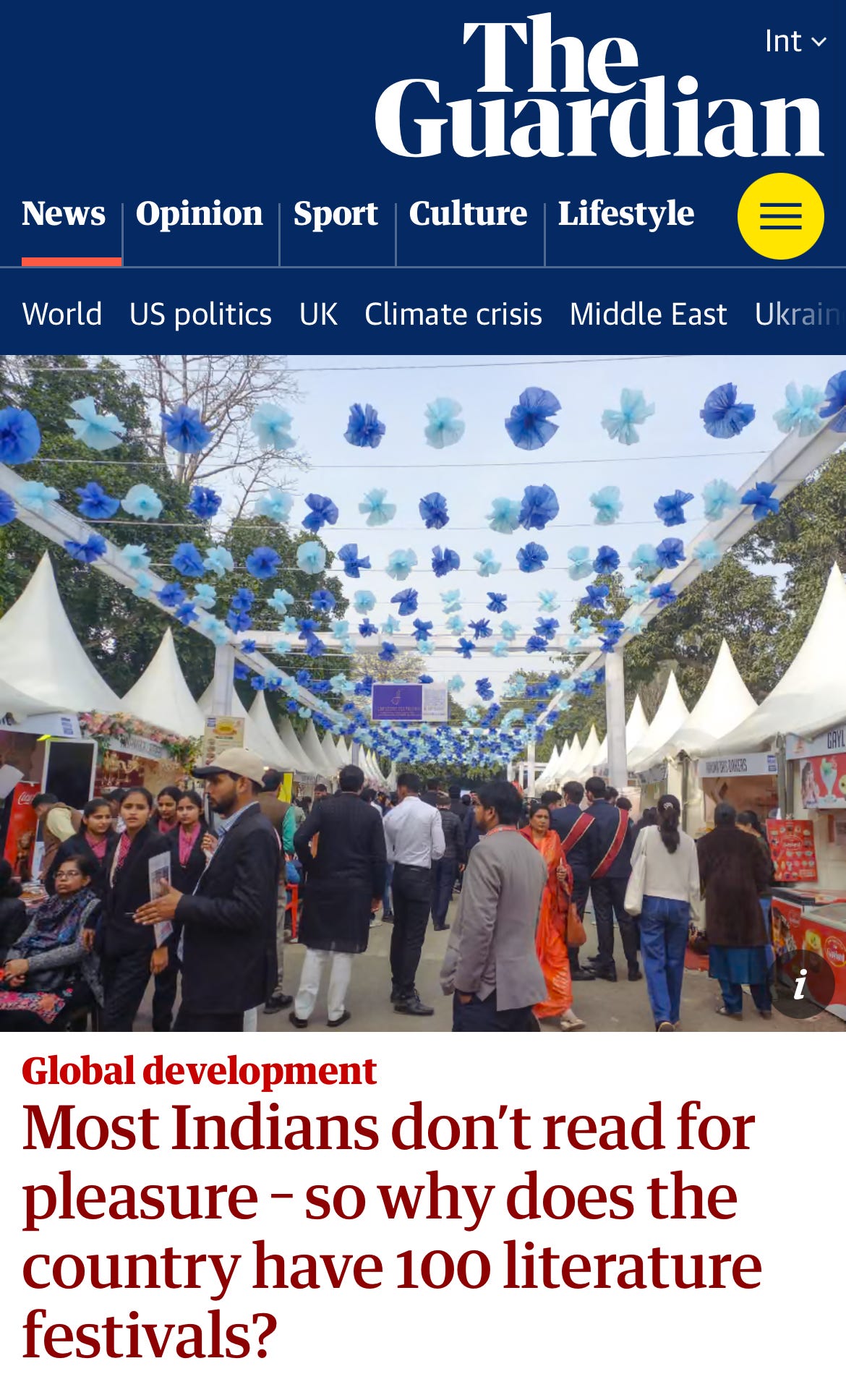
The article itself was ordinary piece of writing. In the beginning it argued that in India a book selling three thousand copies is fairly typical. Ten thousand copies is considered a bestseller. This is true that in a country of over a billion people, those numbers appear small. By the end, the author even acknowledged that literature festivals raise awareness, and that if a handful of people hear something they remember for life, it is worth it. It was hardly a demolition of Indian literary culture.
The headline is clearly clickbait, but I still could not understand the anger. Why are we offended if someone says we are not reading for pleasure? Perhaps the larger issue is that we are limited in what we mean when we use the term- reading culture.
For a large part of India, reading has never been detached from purpose. It is tied to utility. It is tied to survival. In a country obsessed with competitive exams, reading must promise a return on investment. The book must lead somewhere. It must produce a rank, a job, a transfer from a small town to a government office where you sit on the chair which for no reason has a white towel.
The schooling system prepares you for this early. You memorise textbooks. You buy guidebooks and what we called in our towns kunjis. You underline paragraphs that may appear in exams. Reading becomes less about wandering and more about targeting. Then come the coaching years. Kota, or towns that resemble it, with coaching academies rising beside tangled electric wires. Now there are many Kotas inside every city. Engineering entrance, medical entrance, banking exams, SSC, police recruitment, state services and yes mother of all- UPSC. Even philosophy or psychology is consumed strategically. If it helps in mains, it is valuable. If not, it is empty indulgence.
This also explains the popularity of self help manuals, Chanakya Neeti editions, books on the power of the subconscious mind, autobiographies of wealthy entrepreneurs. There were even news reports in 2009 about Mein Kampf being promoted in some business schools as a management guide. In such a climate, you begin to extract purpose from every minute spent turning a page. The purpose becomes bigger than the context.
For millions, books are bridges between their present life and a more stable one. The pleasure of reading is replaced by the necessity of reading. A novel may expand the mind, but an exam guide expands opportunity. That mentality shapes a certain kind of reading culture.
And yes this produces a particular reading habit. Anxious, goal driven, instrumental. Far removed from the image of leisure reading by the sea. The Indian reader is more likely to be reading at a plastic table under a tube light, with a ticking clock and a family expectation hovering nearby. Context changes the meaning of reading.
And yet, pleasure does exist. Even in non metro towns, people read romantic fiction. They read crime thrillers. They consume mythology retellings on their phones. They follow web novels. Newspaper reading culture remains strong in most regions. Magazine culture once shaped entire generations and still survives in pockets. These too are part of reading culture.
In fact the most under discussed part of reading culture of India is Ambedkarite reading culture. Every year, lakhs of people gather at Deekshabhoomi on Dhamma Chakra Pravartan Din, and along with prayer and remembrance, books become central to the experience. The grounds around the stupa turn into a vast open book market where stalls sell the writings of B. R. Ambedkar, Buddhist texts, pamphlets on caste, biographies, speeches, and contemporary Ambedkarite literature. For many visitors, buying books is not decorative consumption but part of the pilgrimage itself. Families arrive prepared to purchase stacks, often carrying them back in cloth bags to their towns and villages. Small publishers rely heavily on these few days, because the scale of sales can surpass what they manage in the rest of the year.
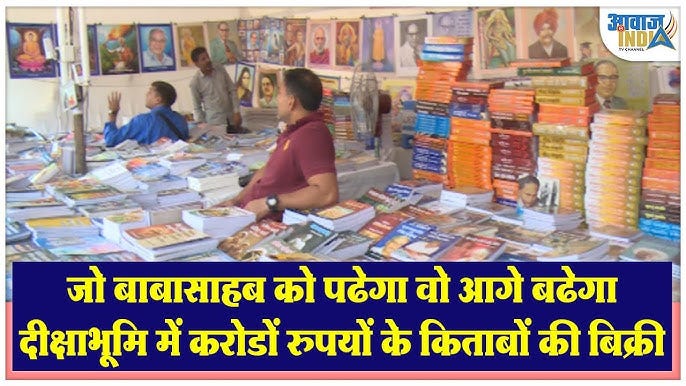
It is one of the rare spaces in India where reading is collective and alive. Here reading may carry pleasure, but more importantly it carries dignity and emancipation. This reading culture rarely appears in the conversations of the self declared bibliophilic world or in elite networks that claim to define literary taste. And most definitely you will not find them on Instagram, where a selfie outside Faqir Chand Bookstore has become the symbolic image of India’s prime urban reading culture.
The idea of reading culture is complex, and the real conversation around it should not be defensive. Perhaps it should be practical. How do we make reading less intimidating? How do we remove the snobbery that surrounds certain classes of readers and self appointed taste makers who call themselves cultural writers, yet rarely look beyond their own class comfort? How do we build strong distribution networks beyond English speaking cities? How do we price books so that buying one does not feel like a luxury?
What India reads, and what we call reading culture, cannot be brushed under a single umbrella. None of this means that India does not read. It means India reads differently. Any serious analysis must pass through the lens of caste and class. Indians do read for pleasure, but they also read anxiously, strategically, and sometimes secretly. They read in languages that rarely enter metropolitan surveys. They read on cheap paper and cracked phone screens, often because income does not allow even the small pleasure of changing a new tempered glass.
And yes if you like to read for ultimate pleasure, you can read my book here.
A lot of “India reads differently” is also: India reads in ways that don’t enter respectable metrics. Second-hand stalls, photocopied pages, pirated PDFs, Telegram groups, WhatsApp forwards of essays, borrowed books that change hands ten times. Publishing statistics are always going to look “small” if the country’s reading ecosystem is partly informal
Also shrinking public libraries. That raises the question, what does India do for pleasure?